| dc.contributor.author | Akter, Farjana | |
| dc.contributor.author | Hamid, Md. Kaysher | |
| dc.date.accessioned | 2026-08-12T14:46:53Z | |
| dc.date.available | 2026-08-12T14:46:53Z | |
| dc.date.issued | 2025-11 | |
| dc.identifier.isbn | 978-984-35-5270-9 | |
| dc.identifier.other | ICEBTM-25-1307 | |
| dc.identifier.uri | https://icebtm.iub.edu.bd | |
| dc.identifier.uri | https://ar.iub.edu.bd/handle/11348/1528 | |
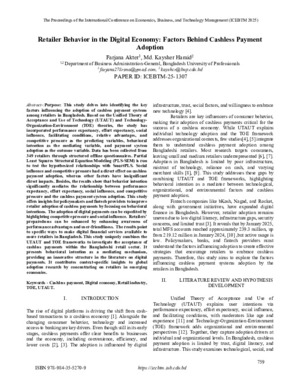
| dc.description.abstract | This study examines the key factors influencing cashless payment adoption among retailers in Bangladesh using the UTAUT and TOE frameworks. Data were collected from 349 retailers and analyzed using PLS-SEM. The findings show that social influence and competitive pressure directly encourage cashless payment adoption, while behavioral intention significantly mediates the effects of performance expectancy, effort expectancy, social influence, and competitive pressure. The study suggests that policymakers and fintech providers can accelerate digital payment adoption by increasing awareness of benefits, improving ease of use, and leveraging social and competitive influences. It contributes context-specific insights into digital payment adoption in emerging economies. | en_US |
| dc.format.extent | pp. 759-766 | |
| dc.language.iso | en | en_US |
| dc.publisher | School of Business and Entrepreneurship, Independent University, Bangladesh (IUB) | en_US |
| dc.source | The Proceedings of the International Conference on Economics, Business and Technology Management (ICEBTM 2025) | |
| dc.subject | Cashless payment | en_US |
| dc.subject | Digital economy | en_US |
| dc.subject | Retail industry | en_US |
| dc.title | Retailer behavior in the digital economy: factors behind cashless payment adoption | en_US |
| dc.type | Conference paper | en_US |
| dc.identifier.doi | https://doi.org/10.67508/iub.icebtm.2025.120 | |