| dc.contributor.author | Alam, Md. Mahbub | |
| dc.contributor.author | Islam, Mohammad Mominul | |
| dc.date.accessioned | 2026-08-08T09:37:09Z | |
| dc.date.available | 2026-08-08T09:37:09Z | |
| dc.date.issued | 2025-11 | |
| dc.identifier.isbn | 978-984-35-5270-9 | |
| dc.identifier.other | ICEBTM-25-1158 | |
| dc.identifier.uri | https://icebtm.iub.edu.bd | |
| dc.identifier.uri | https://ar.iub.edu.bd/handle/11348/1474 | |
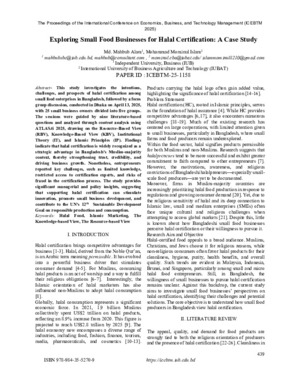
| dc.description.abstract | This study examines the intentions, challenges, and prospects of halal certification among small food enterprises in Bangladesh. Based on a focus group discussion with 25 small business owners in Dhaka, the findings show that halal certification is viewed as a strategic advantage that enhances consumer trust, business credibility, and growth. However, entrepreneurs face challenges including limited knowledge, inadequate access to certification experts, and concerns about fraudulent certification. The study highlights the importance of managerial and policy support for halal certification to encourage innovation, strengthen small businesses, and promote responsible production and consumption in line with UN Sustainable Development Goal 12. | en_US |
| dc.format.extent | pp. 439-450 | |
| dc.language.iso | en | en_US |
| dc.publisher | School of Business and Entrepreneurship, Independent University, Bangladesh (IUB) | en_US |
| dc.source | The Proceedings of the International Conference on Economics, Business and Technology Management (ICEBTM 2025) | |
| dc.subject | Halal food | en_US |
| dc.subject | Islamic marketing | en_US |
| dc.subject | The knowledge-based view | en_US |
| dc.subject | The resource-based view | en_US |
| dc.title | Exploring Small Food Businesses for Halal Certification: A Case Study | en_US |
| dc.type | Conference paper | en_US |
| dc.identifier.doi | Exploring Small Food Businesses for Halal Certification: A Case Study | |