| dc.contributor.author | Rahad, Md. Tazuare Rahman | |
| dc.contributor.author | Nushin, Rimtaha Saima | |
| dc.contributor.author | Akter, Sammi | |
| dc.contributor.author | Rodela, Syeda Farhin | |
| dc.contributor.author | Sarker, Md. Shahed Hossan | |
| dc.contributor.author | Ahmmed, Md. Mortuza | |
| dc.date.accessioned | 2026-08-02T08:19:18Z | |
| dc.date.available | 2026-08-02T08:19:18Z | |
| dc.date.issued | 2025-11 | |
| dc.identifier.isbn | 978-984-35-5270-9 | |
| dc.identifier.other | ICEBTM-25-1039 | |
| dc.identifier.uri | https://icebtm.iub.edu.bd | |
| dc.identifier.uri | https://ar.iub.edu.bd/handle/11348/1417 | |
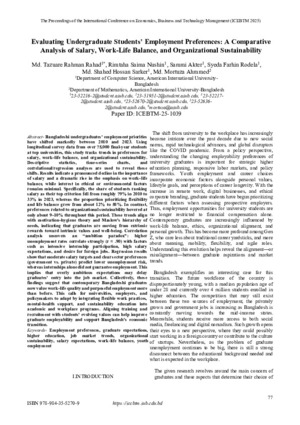
| dc.description.abstract | Bangladeshi undergraduates’ employment priorities have shifted markedly between 2010 and 2023. Using longitudinal survey data from over 75,000 final-year students at top universities, this study tracks trends in preferences for salary, work–life balance, and organizational sustainability. Descriptive statistics, time-series charts, and correlational/regression analyses are used to reveal these shifts. Results indicate a pronounced decline in the importance of salary and a dramatic rise in the emphasis on work–life balance, while interest in ethical or environmental factors remains minimal. Specifically, the share of students ranking salary as their top criterion fell from roughly 79% in 2010 to 33% in 2023, whereas the proportion prioritizing flexibility and life balance grew from about 12% to 58%. In contrast, preferences related to organizational sustainability hovered at only about 9–10% throughout this period. These trends align with motivation–hygiene theory and Maslow’s hierarchy of needs, indicating that graduates are moving from extrinsic rewards toward intrinsic values and well-being. Correlation analysis uncovers an “ambition paradox”: higher unemployment rates correlate strongly (r ≈ .90) with factors such as intensive internship participation, high-salary expectations, and desire for foreign jobs. Regression results show that moderate salary targets and clear sector preferences (government vs. private) predict lower unemployment risk, whereas internships alone did not guarantee employment. This implies that overly ambitious expectations may delay graduates’ entry into the job market. Collectively, these findings suggest that contemporary Bangladeshi graduates now value work–life quality and purposeful employment more than before. This calls for universities, employers, and policymakers to adapt by integrating flexible work practices, mental-health support, and sustainability education into academic and workplace programs. Aligning training and recruitment with students’ evolving values can help improve graduate employability and support Bangladesh’s economic transition. | en_US |
| dc.format.extent | pp. 77-83 | |
| dc.language.iso | en | en_US |
| dc.publisher | School of Business and Entrepreneurship, Independent University, Bangladesh (IUB) | en_US |
| dc.source | The Proceedings of the International Conference on Economics, Business and Technology Management (ICEBTM 2025) | |
| dc.subject | Employment preferences | en_US |
| dc.subject | Graduate expectations | en_US |
| dc.subject | Higher education | en_US |
| dc.subject | Job market trends | en_US |
| dc.subject | Organizational sustainability | en_US |
| dc.subject | Salary expectations | en_US |
| dc.subject | Work-life balance | en_US |
| dc.subject | Youth Employment | en_US |
| dc.title | Evaluating Undergraduate Students’ Employment Preferences: A Comparative Analysis of Salary, Work-Life Balance, and Organizational Sustainability | en_US |
| dc.type | Conference paper | en_US |
| dc.identifier.doi | https://doi.org/10.67508/iub.icebtm.2025.013 | |