| dc.contributor.author | Kabir, Effat Binte | |
| dc.contributor.author | Fatama, Mst. Kaniz | |
| dc.contributor.author | Tayeba, Rifa Tashfia | |
| dc.contributor.author | Kamal, Nabila | |
| dc.date.accessioned | 2026-07-14T08:46:55Z | |
| dc.date.available | 2026-07-14T08:46:55Z | |
| dc.date.issued | 2026-06 | |
| dc.identifier.issn | 25212990 | |
| dc.identifier.uri | https://ar.iub.edu.bd/handle/11348/1389 | |
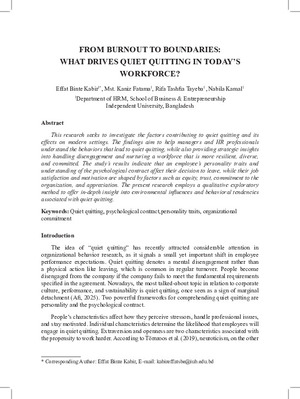
| dc.description.abstract | This research seeks to investigate the factors contributing to quiet quitting and its effects on modern settings. The findings aim to help managers and HR professionals understand the behaviors that lead to quiet quitting, while also providing strategic insights into handling disengagement and nurturing a workforce that is more resilient, diverse, and committed. The study’s results indicate that an employee’s personality traits and understanding of the psychological contract affect their decision to leave, while their job satisfaction and motivation are shaped by factors such as equity, trust, commitment to the organization, and appreciation. The present research employs a qualitative exploratory method to offer in-depth insight into environmental influences and behavioral tendencies associated with quiet quitting. | en_US |
| dc.language.iso | en | en_US |
| dc.publisher | School of Business and Entrepreneurship, Independent University, Bangladesh | en_US |
| dc.relation.ispartofseries | Independent Business Review;Vol 15 | |
| dc.relation.hasversion | https://ibr.iub.edu.bd/Journals/article/view/35 | |
| dc.subject | Quiet quitting | en_US |
| dc.subject | Psychological contract | en_US |
| dc.subject | Personality traits | en_US |
| dc.subject | Organizational Commitment | en_US |
| dc.title | From burnout to boundaries: what drives quiet quitting in today’s workforce? | en_US |
| dc.type | Article | en_US |
| dc.identifier.doi | https://doi.org/10.67508/iub.icebtm.2025.091 | |