
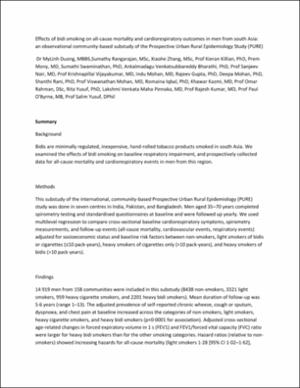
Effects of bidi smoking on all-cause mortality and cardiorespiratory outcomes in men from south Asia: an observational community-based substudy of the Prospective Urban Rural Epidemiology Study (PURE)
Abstract
Summary
Background
Bidis are minimally regulated, inexpensive, hand-rolled tobacco products smoked in south Asia. We examined the effects of bidi smoking on baseline respiratory impairment, and prospectively collected data for all-cause mortality and cardiorespiratory events in men from this region.
Methods
This substudy of the international, community-based Prospective Urban Rural Epidemiology (PURE) study was done in seven centres in India, Pakistan, and Bangladesh. Men aged 35–70 years completed spirometry testing and standardised questionnaires at baseline and were followed up yearly. We used multilevel regression to compare cross-sectional baseline cardiorespiratory symptoms, spirometry measurements, and follow-up events (all-cause mortality, cardiovascular events, respiratory events) adjusted for socioeconomic status and baseline risk factors between non-smokers, light smokers of bidis or cigarettes (≤10 pack-years), heavy smokers of cigarettes only (>10 pack-years), and heavy smokers of bidis (>10 pack-years).
Findings
14 919 men from 158 communities were included in this substudy (8438 non-smokers, 3321 light smokers, 959 heavy cigarette smokers, and 2201 heavy bidi smokers). Mean duration of follow-up was 5·6 years (range 1–13). The adjusted prevalence of self-reported chronic wheeze, cough or sputum, dyspnoea, and chest pain at baseline increased across the categories of non-smokers, light smokers, heavy cigarette smokers, and heavy bidi smokers (p<0·0001 for association). Adjusted cross-sectional age-related changes in forced expiratory volume in 1 s (FEV1) and FEV1/forced vital capacity (FVC) ratio were larger for heavy bidi smokers than for the other smoking categories. Hazard ratios (relative to non-smokers) showed increasing hazards for all-cause mortality (light smokers 1·28 [95% CI 1·02–1·62], heavy cigarette smokers 1·59 [1·13–2·24], heavy bidi smokers 1·56 [1·22–1·98]), cardiovascular events (1·45 [1·13–1·84], 1·47 [1·05–2·06], 1·55 [1·17–2·06], respectively) and respiratory events (1·30 [0·91–1·85], 1·21 [0·70–2·07], 1·73 [1·23–2·45], respectively) across the smoking categories.
Interpretation
Bidi smoking is associated with severe baseline respiratory impairment, all-cause mortality, and cardiorespiratory outcomes. Stricter controls and regulation of bidis are needed to reduce the tobacco-related disease burden in south Asia.
Funding
Population Health Research Institute, Canadian Institutes of Health Research, and Heart and Stroke Foundation of Ontario.
DOI: http://dx.doi.org/10.1016/S2214-109X(17)30004-9
Collections
- Article [2]
Publisher:
The Lancet, Global Health
Type:
Article
Keywords:
tobacco products, south Asia