
Tagore and Nazrul Islam: Vision & Poetry
Abstract
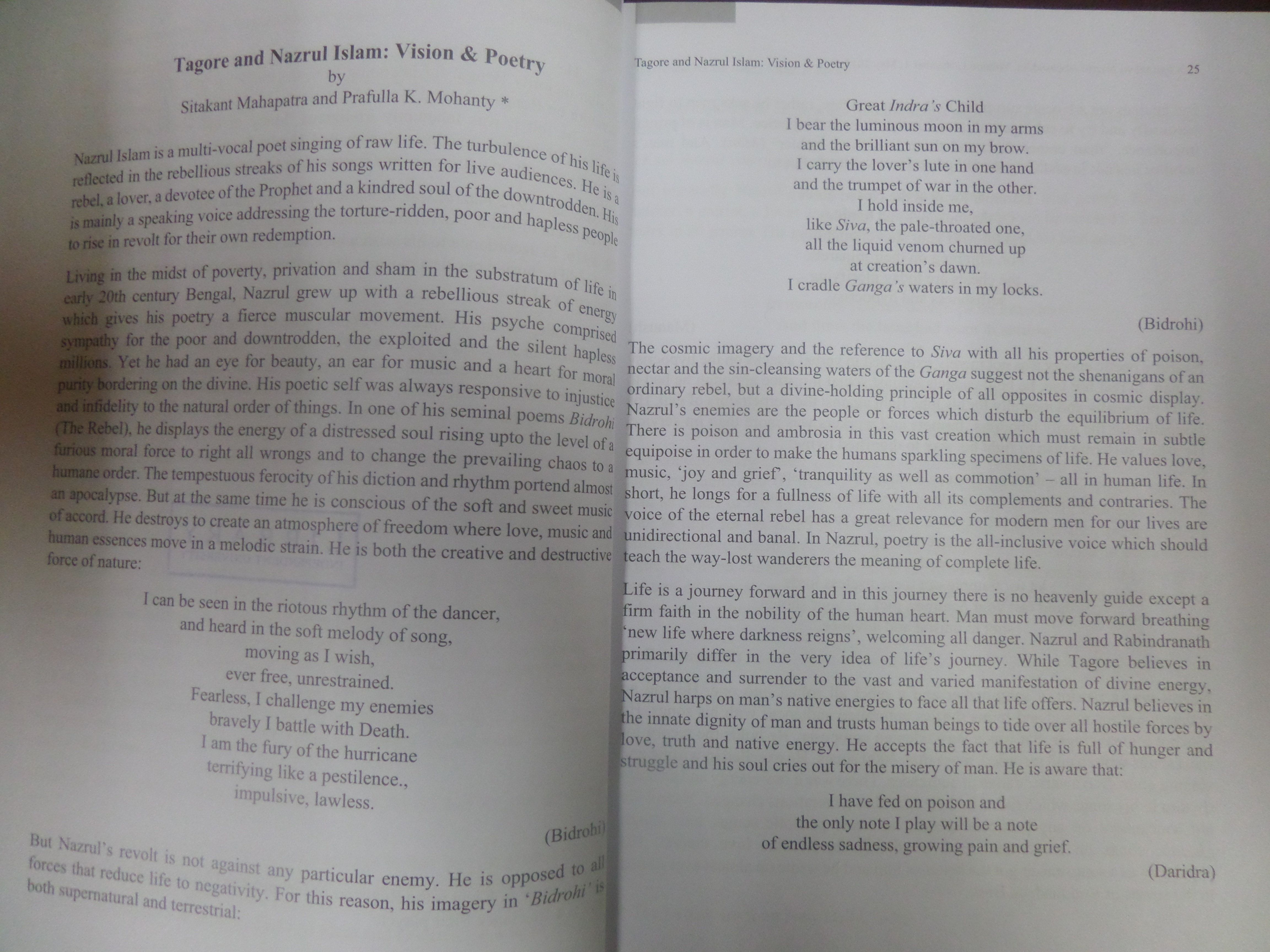
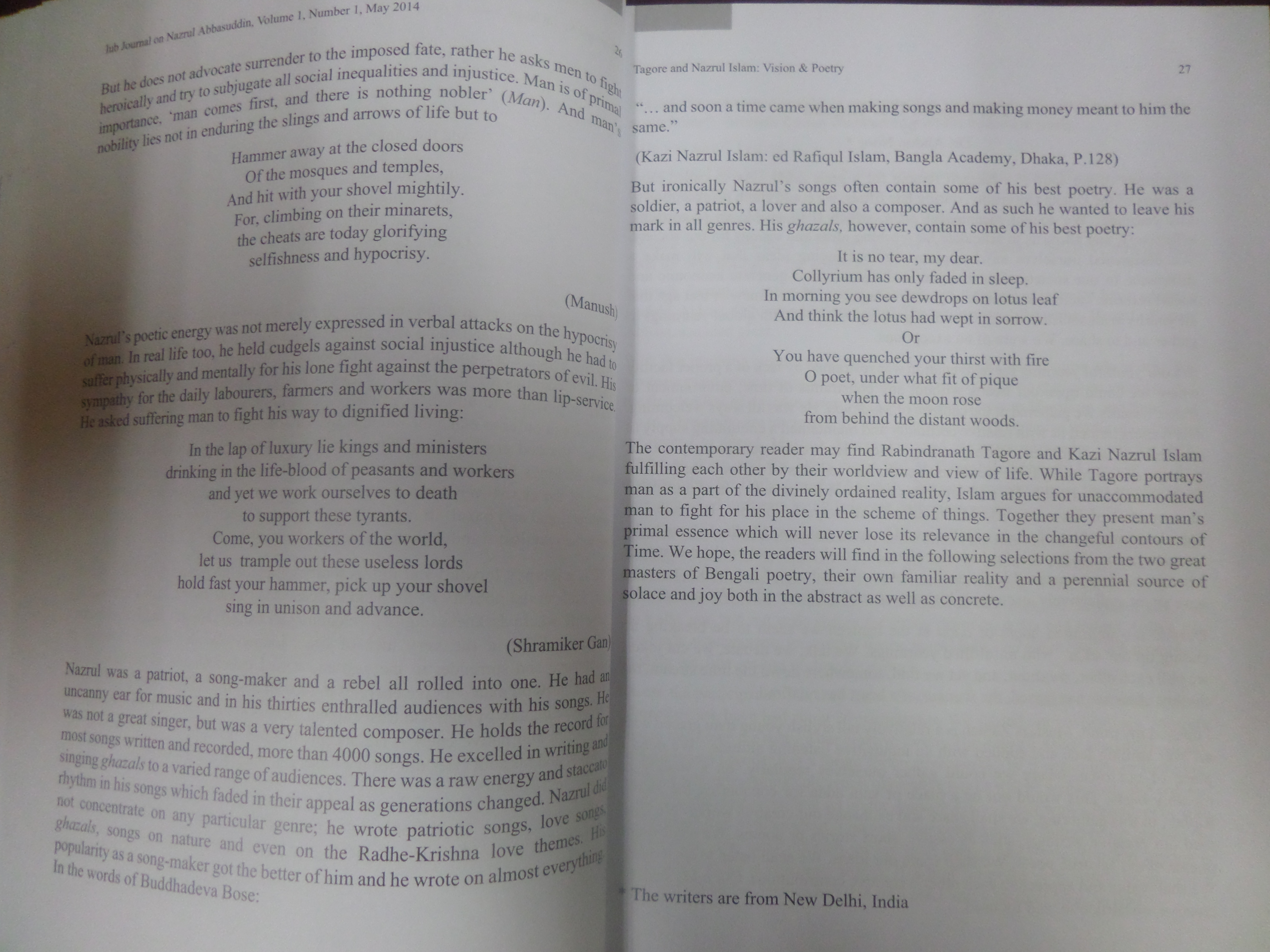
Nazrul Islam is a multi-vocal poet singing of raw life. The turbulence of his life j reflected in the rebellious streaks of his songs written for live audiences. He i$a rebels lover, a devotee of the Prophet and a kindred soul of the downtrodden. His is mainh a speaking voice addressing the torture-ridden, poor and hapless people to rise in revolt for their own redemption. Living in the midst of poverty, privation and sham in the substratum of life in early 20th century Bengal, Nazrul grew up with a rebellious streak of energy which feres his poetry a fierce muscular movement. His psyche comprised Hn for the poor and downtrodden, the exploited and the silent hapless Yet he had an eye for beauty, an ear for music and a heart for moral ferine Tagore and Nazrul Islam: Vision &. Poetry
Great Indra’s Child I bear the luminous moon in my arms and the brilliant sun on my brow. I carry the lover’s lute in one hand and the trumpet of war in the other.
I hold inside me, like Siva, the pale-throated one, all the liquid venom churned up at creation’s dawn. I cradle Ganga’s waters in my locks. 25 (Bidrohi) The cosmic imagery and the reference to Siva with all his properties of poison, nectar and the sin-cleansing waters of the Ganga suggest not the shenanigans of an ordinary rebel, but a divine-holding principle of all opposites in cosmic display. 8 ® to divine- Hls P°etic self was alway§ responsive to injustice L ]>s enemies are the people 0[. forces which djsturb the equiljbrillm of ,ife to the natural order of things. In one of his seminal poems Bidrohi There is poison and ambrosia in this vast creation which must remajn in subtle he displays the energy of a distressed soul rising upto the level of a equipoise in order to make the humans sparkling specimens of life. He values love, ■Knoral force to right all wrongs and to change the prevailing chaos to a|nlusjCj <joy and grief, ‘tranquility as well as commotion’ - all in human life. In ^MBfeder. The tempestoous ferocity of his diction and rhythm portend almost short, he longs for a fullness of life with all its complements and contraries. The an apocalypse. But at the same time he is conscious of the soft and sweet music voice of the eternal rebel has a great relevance for modem men for our lives are of accord. He destroys to create an atmosphere of freedom where love, music and; ./Unidirectional and banal. In Nazrul, poetry is the all-inclusive voice which should human essences move in a melodic strain. He is both the creative and destructive Beach the way-lost wanderers the meaning of complete life.
life is a journey forward and in this journey there is no heavenly guide except a Krm faith in the nobility of the human heart. Man must move forward breathing
I new life where darkness reigns’, welcoming all danger. Nazrul and Rabindranath irimarily differ in the very idea of life’s journey. While Tagore believes in ^acceptance and surrender to the vast and varied manifestation of divine energy, azrul harps on man’s native energies to face all that life offers. Nazrul believes in fie innate dignity of man and trusts human beings to tide over all hostile forces by [ove, truth and native energy. He accepts the fact that life is full of hunger and truggle and his soul cries out for the misery of man. He is aware that: I can be seen in the riotous rhythm of the dancer, and heard in the soft melody of song, moving as I wish, ever free, unrestrained. Fearless, I challenge my enemies bravely I battle with Death. I am the fury of the hurricane terrifying like a pestilence., impulsive, lawless. (Bidrohi) I have fed on poison and the only note I play will be a note of endless sadness, growing pain and grief
Collections
Publisher:
Kazi Nazrul Islam and Abbasuddin Ahmed Research & Study Centre, Independent University, Bangladesh
Type:
Article
Keywords:
rebels lover, Tagore, Rabindranath, Bengali Literature, Kazi Nazrul islam