
UGC’s GPA rules are driving away the talent Bangladesh needs
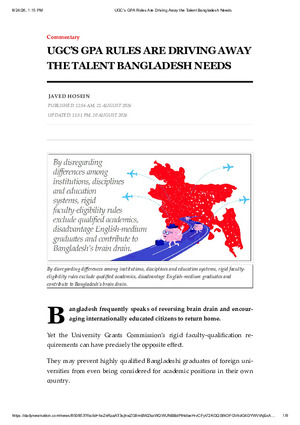
Abstract
This study examines how rigid faculty-qualification requirements imposed by the University Grants Commission (UGC) may contribute to brain drain in Bangladesh by restricting the recruitment of internationally educated Bangladeshi academics. The discussion focuses particularly on minimum academic grade requirements at different stages of education, including SSC or equivalent, HSC or equivalent, undergraduate, and graduate levels. It argues that a single CGPA threshold cannot adequately represent academic ability because grading systems, institutional standards, curricula, assessment methods, and disciplinary practices vary considerably across universities and countries. The study highlights the difficulties of comparing qualifications from internationally recognised institutions, such as Oxford, with numerical CGPA-based systems. It further argues that rigid grade-based screening may disadvantage candidates from demanding academic programmes, internationally educated Bangladeshis, and individuals who demonstrate significant academic improvement later in their careers. Such restrictions may discourage qualified scholars from returning to Bangladesh and thereby contribute to the loss of research expertise, international networks, teaching experience, and professional knowledge. The study proposes replacing mandatory GPA-based filtering with holistic academic assessment that considers institutional standing, research and publications, teaching ability, professional experience, recommendations, disciplinary context, and evidence of academic growth. It concludes that UGC should focus on institutional quality and integrity while allowing universities greater autonomy in evaluating faculty candidates.
Collections
- 2026 [44]
Publisher:
The New Nation
Type:
Newspaper Article
Keywords:
Brain drain, Faculty qualification requirements, Academic Grade Inflation, International Qualifications, CGPA-Based Recruitment